Bitcoin’s Volatility Falls Within S&P 500 Range, Grayscale Research Says
10/20/2026 / By Sterling Ashworth

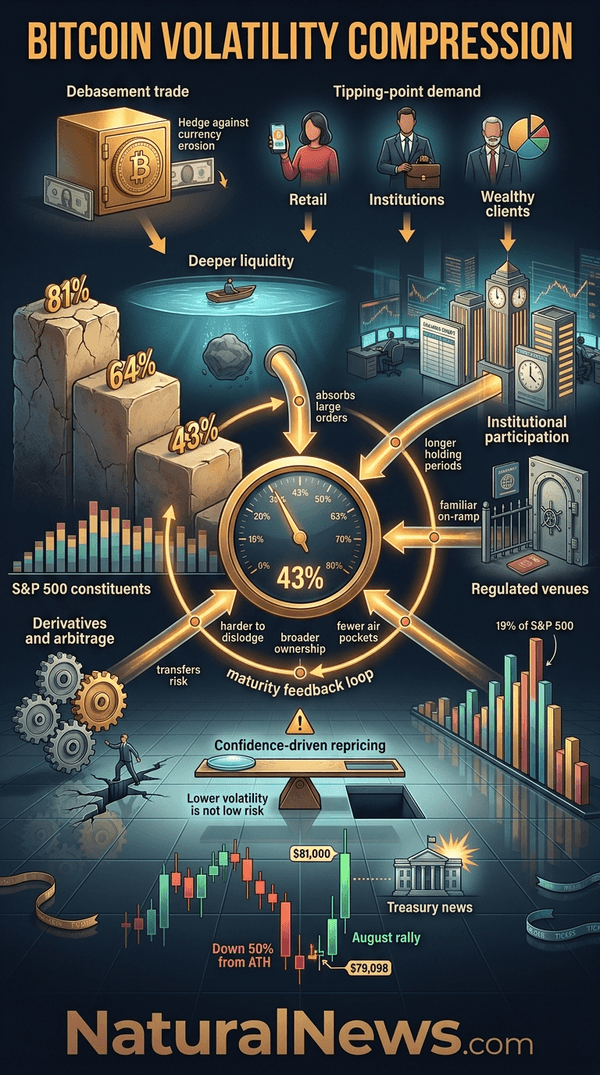
Bitcoin’s one-year realized volatility has declined to 43%, a level that now sits within the distribution of S&P 500 constituents, according to a research note released Wednesday by crypto asset manager Grayscale. The figure is down from an average of 64% over the past 10 years and 81% five years ago, the report stated, and is now lower than that of 19% of S&P 500 stocks [1][2].
Zach Pandl, Grayscale’s head of research, wrote in the note that deeper liquidity, broader institutional participation and more regulated access venues have narrowed bitcoin’s price swings.
The findings, first reported by Bitcoin Magazine, coincide with a period in which bitcoin has recovered from a sharp drawdown earlier in 2026 but remains below its record high.
Grayscale: Bitcoin’s Price Swings Narrow as Market Matures
According to the Grayscale report, bitcoin’s realized volatility now falls within the same range as a number of S&P 500 stocks, with a meaningful number of large-cap equities exhibiting more price swings than the digital asset. According to research from crypto asset manager Grayscale, the digital coin’s realized volatility fell within the distribution of S&P 500 constituents — with a meaningful number of large-cap stocks exhibiting more price swings [1].
The trend is not limited to the past year. Bitcoin’s realized volatility has been steadily compressing over a longer horizon, reflecting the gradual maturation of the asset class and the deepening of the markets in which it trades.
The maturation of the asset has been accompanied by a broader shift in how Wall Street approaches cryptocurrencies. Banks, brokerages and exchanges have accelerated their push into crypto products in 2026, according to an Axios report, as demand from retail investors, institutions and wealthy clients reaches a tipping point [3].
Price History: 2026 Drawdown and Recovery
Bitcoin at one point in 2026 was down more than 50% from the all-time high it reached last October, according to price data.
The coin’s price surged in August and September, giving it its best quarter in years and leading a number of analysts to declare it was back in a bull market, according to reports. In August, bitcoin benefited from news that the U.S. Treasury was preparing to announce measures that market participants viewed as supportive of alternative stores of value.
The August rally pushed bitcoin past $81,000, its highest price since January, before it pulled back to trade near $79,098 in New York, according to market data. The 23% weekly gain was attributed in part to the Treasury’s announcement [4].
Debasement Trade and Dollar Weakness Cited
The debasement trade, which reflects investor concern about the erosion of purchasing power in fiat currencies, has been cited as one factor supporting demand for bitcoin even as its volatility profile changes.
Grayscale’s report attributes bitcoin’s lower volatility to maturity, deeper liquidity, broader institutional participation and more regulated access venues. Grayscale research found that bitcoin’s realized volatility fell within the distribution of S&P 500 constituents, with a meaningful number of large-cap stocks exhibiting more price swings [1].
The report does not state that lower volatility eliminates price risk, and officials have said the data should not be read as a guarantee against future drawdowns. Independent analysts have noted that bitcoin’s valuations are driven by market participants’ confidence, which can shift without warning [5].
Outlook: Volatility Data Does Not Eliminate Risks
Grayscale says bitcoin’s price swings have narrowed considerably from the extremes of its early years, but the report does not say bitcoin is risk-free.
Pandl said allocation sizing, rather than the ownership question, is now the focus for investors comfortable with volatile assets.
K33 data indicates 2025 was the least volatile year for bitcoin so far. Analysts have said future price swings cannot be predicted, and the Grayscale report itself stops short of forecasting that bitcoin’s volatility will remain at current levels. Observers have also noted that institutional investors are increasingly exploring digital assets as a way to diversify portfolios and hedge against the secular bear market in traditional equities [6].
References
- Bitcoin’s Volatility Has Fallen To S&P 500 Ranks: Grayscale. https://bitcoinmagazine.com/news/bitcoins-volatility-has-fallen-study-shows
- Bitcoin’s Volatility Has Fallen To S&P 500 Ranks: Grayscale (2026). https://turfturfturf.com/article/bitcoin-s-volatility-has-fallen-to-s-p-500-ranks-grayscale
- Traditional Finance Rushes Into Crypto as Institutions Buy Bitcoin Dip, Axios Reports – NaturalNews.com, June 14, 2026.
- Bitcoin Tops $81,000 as Dollar Weakens, Raising Questions About “Debasement Trade” – NaturalNews.com, August 26, 2026.
- Brighteon Broadcast News by Mike Adams – Brighteon.com
- Mike Adams interview with Chris Sullivan – April 1 2025 by Mike Adams
Explainer Infographic
Submit a correction >>
Tagged Under:
bitcoin, Bitcoin collapse, Bubble, crypto cult, cryptocurrency, currency crash, currency reset, investing, market crash, money supply, pensions, price dip, risk, S&P 500, volatility
This article may contain statements that reflect the opinion of the author
RECENT NEWS & ARTICLES