The sleeping giant: America’s overlooked seismic threat stirs anew
12/20/2025 / By Willow Tohi
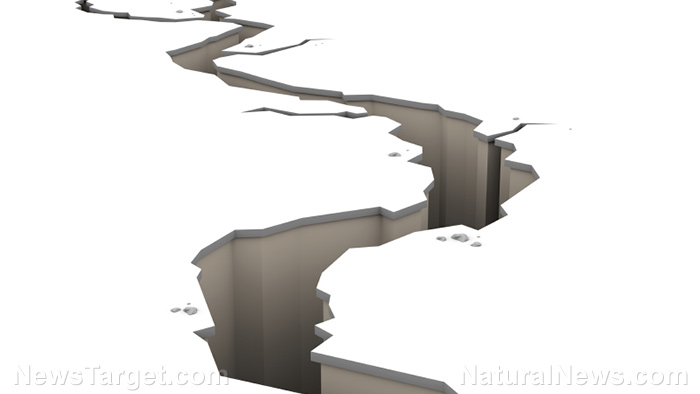
- A recent swarm of minor earthquakes along the New Madrid Seismic Zone has renewed focus on the significant, underappreciated seismic threat to America’s Heartland.
- The zone, spanning eight states, is overdue for a major earthquake, with a 40% chance of a magnitude 6.0 event within 50 years.
- A repeat of the catastrophic 1811-1812 quakes could cause tens of thousands of casualties and hundreds of billions in damage.
- Infrastructure in the central U.S. is not built to modern seismic standards, amplifying the potential impact.
- New federal models show nearly 75% of the U.S. is at risk for damaging earthquakes, underscoring a national preparedness challenge.
In the quiet lands of the central United States, far from the famed fault lines of California, a geological giant is showing subtle signs of life. Since mid-November, the U.S. Geological Survey has recorded dozens of minor earthquakes along the New Madrid Seismic Zone, a network of faults stretching beneath eight states in the Mississippi River Valley. While these tremors are routine and too faint for residents to feel, their timing is unnerving. The activity coincides with the anniversary of the catastrophic 1811-1812 earthquakes that rang church bells in Boston and altered the course of the Mississippi River. For national security and emergency management officials, the faint rumbles are a stark reminder that one of the nation’s most severe natural threats lies dormant in its vulnerable interior, where preparedness lags dangerously behind the potential peril.
A history written in tremors
The contemporary risk is framed by a historical cataclysm. Between December 1811 and February 1812, a series of at least three massive earthquakes—each estimated above magnitude 7.0—devastated the sparsely populated frontier. The New Madrid earthquakes remain the most powerful seismic events ever recorded east of the Rocky Mountains. Scientists calculate that quakes of such magnitude recur in this zone every 200 to 800 years, placing the region squarely within the window for another major event.
The geological mystery of New Madrid compounds the threat. Unlike the well-understood boundary faults in California, this seismic zone is an “intraplate” anomaly, situated in the middle of the stable North American tectonic plate. It activates along ancient, buried weaknesses, a process researchers admit they do not fully comprehend. This scientific uncertainty makes precise prediction impossible, transforming the region’s risk from a theoretical concern into a persistent and unpredictable vulnerability.
The staggering cost of a modern catastrophe
Modern analysis paints a grim picture of what a repeat of the 1811-1812 sequence would entail. A 2025 assessment warned a magnitude 7.6 quake could cause over $43 billion in direct damage. More comprehensive studies, modeling a magnitude 7.7 event near Memphis, project a far grimmer reality:
- Over 86,000 casualties and injuries.
- Damage to 715,000 buildings.
- Widespread loss of power and critical infrastructure.
The total economic impact, including indirect costs from severed supply chains and lost employment, could approach $600 billion. The human and economic shockwaves would ripple far beyond the epicenter, affecting national logistics, agriculture and energy networks, constituting a profound domestic crisis.
A region structurally unprepared
The core of the preparedness gap is structural. Building codes in California and other active seismic regions mandate strict engineering to withstand ground shaking. In contrast, much of the infrastructure across the Midwest and South is designed for more common threats like tornadoes and severe storms, not the deep, prolonged shaking of a major earthquake. As experts note, a magnitude 6.0 quake in Missouri would likely cause far greater destruction than a similar event in California due to this structural vulnerability. With over 11 million people living within the high-risk zone, including major population centers like Memphis and St. Louis, the potential for a high-casualty disaster is acute.
A national risk profile expands
The New Madrid threat exists within a newly understood national context. The U.S. Geological Survey’s 2023 National Seismic Hazard Model, a comprehensive update involving over 50 scientists, concluded that nearly 75 percent of the United States could experience damaging earthquake shaking. This model, the first to encompass all 50 states simultaneously, identifies significant hazard along the Atlantic Coastal corridor and reaffirms the persistent danger in California and Alaska. It underscores that seismic risk is not a regional issue, but a widespread national one. The model serves as a crucial tool for engineers and policymakers, emphasizing that mitigation and preparedness must be prioritized far beyond traditional earthquake country.
A call for vigilance in the quiet
The recent subtle tremors along the New Madrid Seismic Zone are not a prediction of imminent doom, but a clarion call for sustained vigilance. They highlight the uneasy truth that a catastrophic event can emerge from the continent’s stable heart with little warning. For the millions of Americans living atop this sleeping giant, the lessons are clear: Individual preparedness through secured homes, emergency kits and knowing how to “drop, cover and hold on” is essential. For the nation, the challenge is broader—to fortify critical infrastructure, update building codes and integrate this inland seismic threat into the core of national security and disaster resilience planning. The quiet land, as history warns, may not remain quiet forever.
Sources for this article include:
Submit a correction >>
Tagged Under:
California, Collapse, dangerous, disaster, disaster resilience, earthquake, national security, New Madrid Seismic Zone, preparedness, Rocky Mountains, scientific
This article may contain statements that reflect the opinion of the author
RECENT NEWS & ARTICLES